
Working with Nature: Street Trees and Stormwater Management (Part I)
This article is the first of two, and written by SSDN’s Environmental Finance Center staff. These centers exist to help communities navigate the complex world of federal funding.
By Catherine Mercier-Baggett, Director of Federal Technical Assistance
Several cities pride themselves for their extensive tree canopy. More than 3,600 communities across the country have made a voluntary commitment to planting and caring for trees and are recognized as a Tree City USA, a program that celebrates its 50th anniversary this year. Trees provide a large number of benefits, from heat mitigation to habitat support, and here we explore their role in assisting stormwater management.
SSDN member states are in the Eastern Temperate Forest ecoregion, with the exception of the very southern tip of Florida and the southwest corner of Louisiana. It is characterized by a humid climate, with somewhat distributed precipitation throughout the seasons. Then why are drought-tolerant tree species heavily favored in urban environments? The answer lies in the microclimates where we plant trees. Urban soils have typically been deeply altered in their physical and chemical compositions, and don’t offer by themselves the support and nutrients necessary for plant growth. They are often compacted and don’t allow for water infiltration. Additionally, landscaped areas are small and typically disconnected from natural flows of water, isolated by concrete curbs and other types of paving. Coupled with other environmental stressors like harsh pruning to provide clearance for vehicles, pedestrians and overhead powerlines, urban trees are often put under immense pressure.
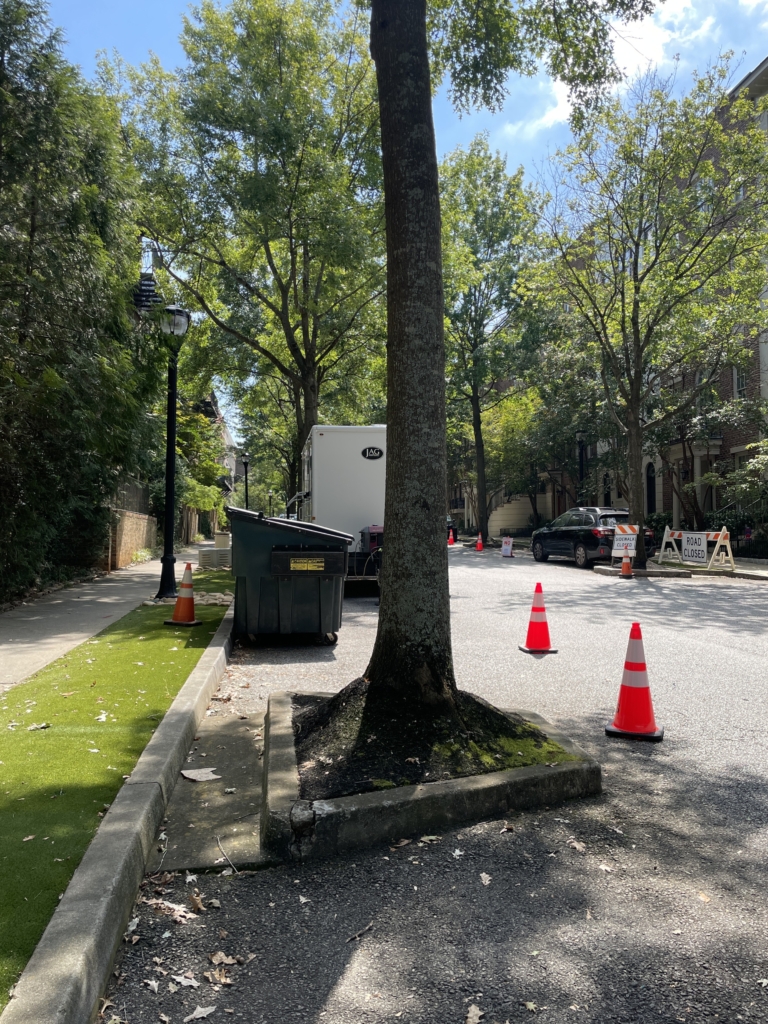
The proposition here is to (re)connect trees with stormwater to support their health, improve water quality and increase infiltration.
How Trees Can Benefit Stormwater Management
In an urban setting, when rain hits impervious surfaces, it concentrates along the edges of pavement, collecting debris and pollutants along the way. Once the runoff reaches the stormwater drain or other discharge point located downhill, it often overwhelms the system, causing overflows and flooding.
Green stormwater infrastructure (GSI) is intended to collect rain where it falls — or as close as possible — and allow it to poolpond temporarily and infiltrate the ground. The growing media (soil) is primarily responsible for the infiltration and capture of pollutants, as the vegetation will absorb water over a longer period of time. Some species can even break down contaminants. Overall, GSI will reduce the volume of water that ends in the stormwater system.
Through its photosynthesis cycle, vegetation will absorb water from the soil and release it in the atmosphere via evapotranspiration. The Green Infrastructure Center, a nonprofit based out of Virginia, developed a tool that estimates the stormwater uptake by trees at the watershed scale. Although studies on evapotranspiration (a proxy measure of water uptake) are increasingly common, information on individual trees is difficult to obtain due to the number of variables involved. It is best to consult with an arborist to determine which species would be suitable to the specific conditions of the site.
Another service provided by vegetation and trees in particular is rainfall interception. The amount of water intercepted depends on several variables that include the tree species (based on leaf shape, branch architecture and other factors), and individual tree characteristics (canopy width, leaf density). By slowing down the speed at which rain reaches the soil, trees can reduce the maximum volume of runoff that reaches the storm drains at once.
Trees cannot solve roadway flooding and water pollution by themselves. While they provide control in the immediate and longer terms, they must be part of an intentionally designed GSI system.
Urban Green Stormwater Practices
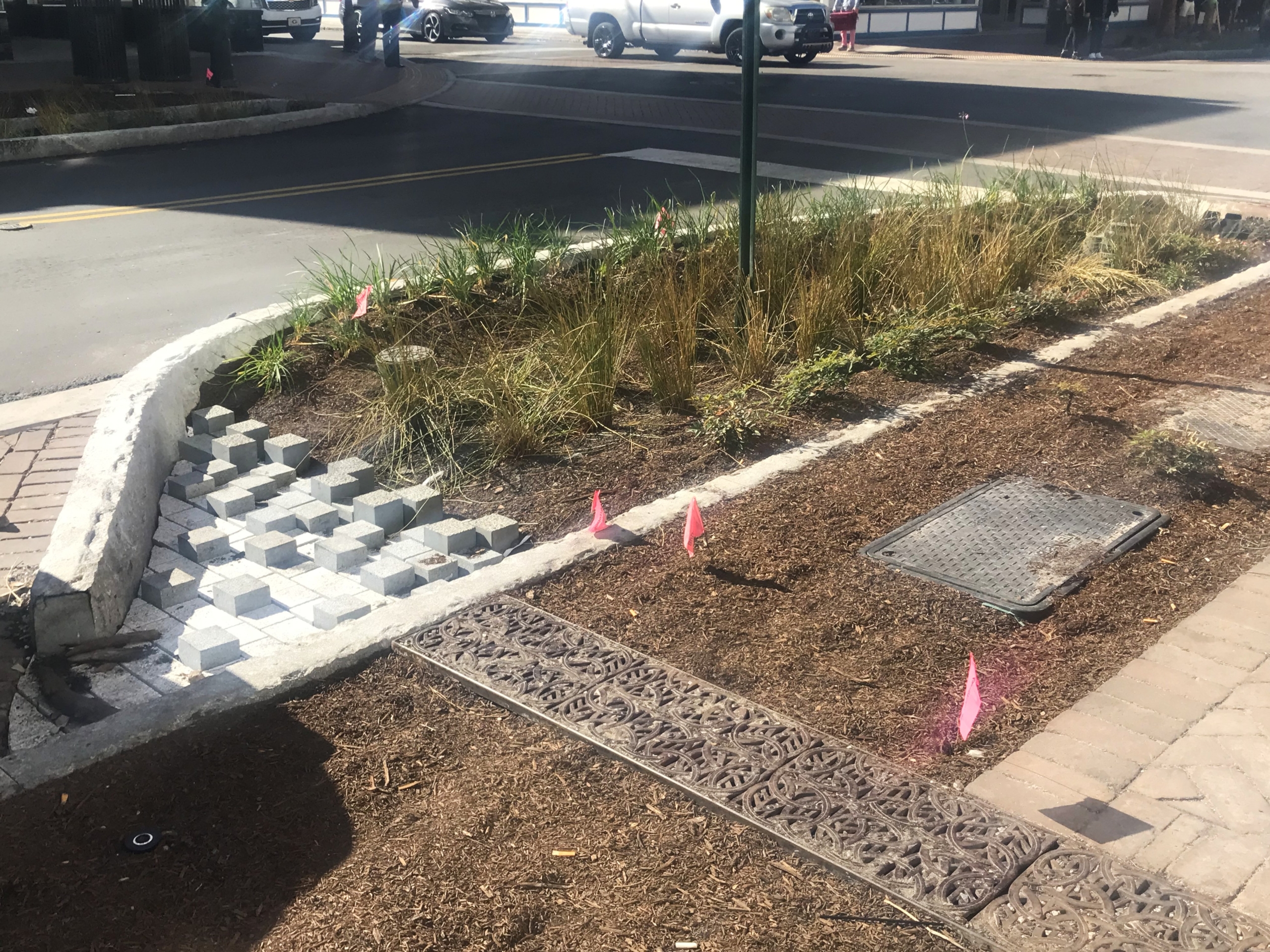
There are a multitude of GSI design types (also called “practices”) that can be customized and combined to respond to the particularities of a site. The U.S. EPA published in 2021 the Green Streets Handbook, a guide that includes technical considerations to integrate vegetated GSI in roadway projects. Stormwater curb extensions, stormwater planters and stormwater tree well systems are among the most suitable options for urban settings. The right solution will depend on several factors such as the type of road users, the amount and quality of runoff to treat, and the area within the right-of-way dedicated to GSI.
Stormwater Curb Extensions
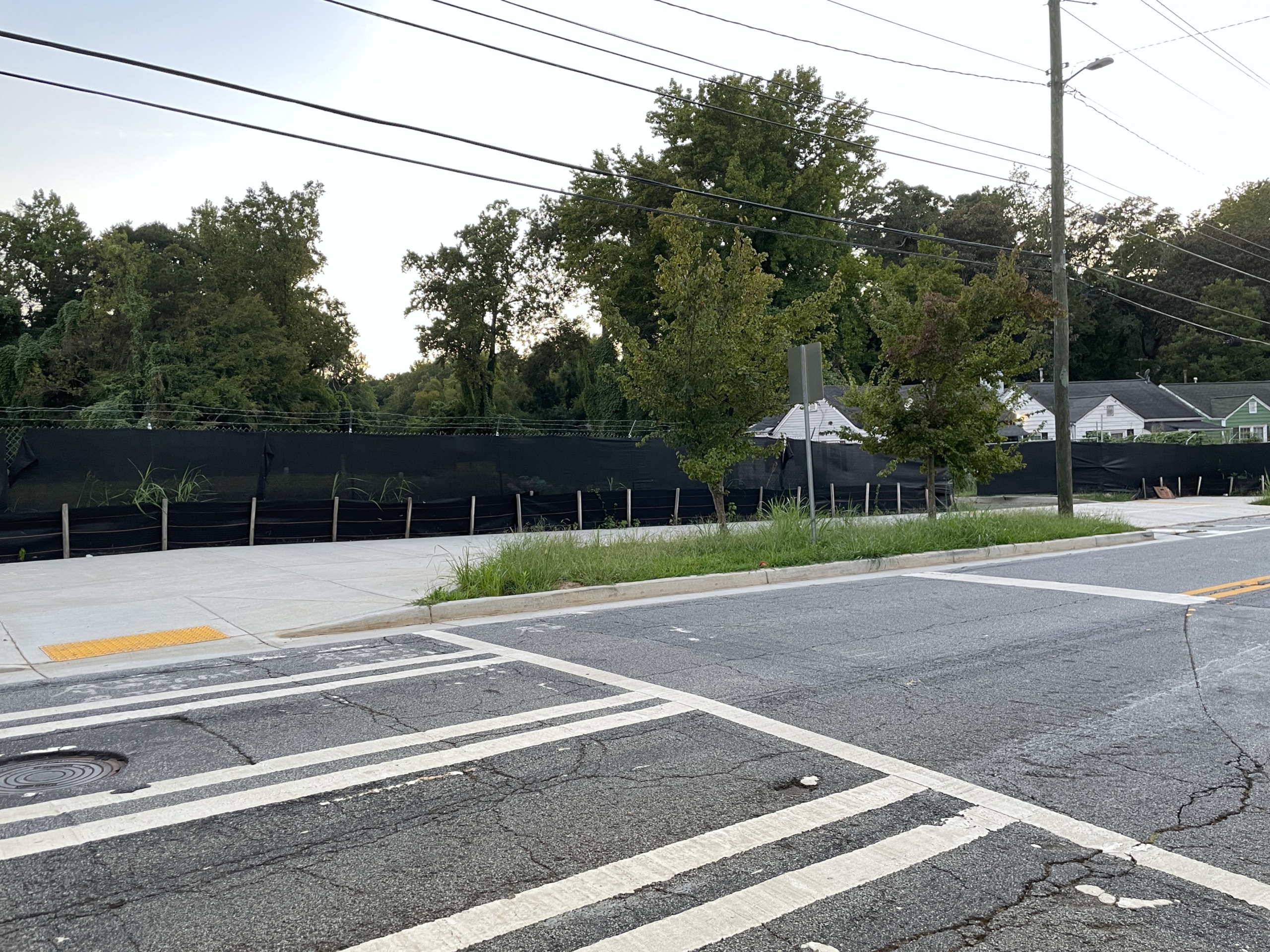
Also called bulb-outs and bump-outs, curb extensions are areas that expand into the driving lanes and reduce the width of pavement available to vehicles. They can be used to visually mark on-street parking or shorten the walking distance at pedestrian crossings. From a stormwater perspective, they offer small planting areas that can combine infiltration and water quality. However planting designs must consider visibility and may not be able to accommodate trees and shrubs, especially near intersections. Curb extensions typically have a curb cut that serves as an inlet at the top and another to release overflow downslope.
Stormwater Planters
In contrast with curb extensions, planters are usually longer and can be used in lieu of planting strips. They can be interconnected to provide a maximum of water quality improvement and significantly slow down runoff. Because sightlines are less of a concern, stormwater planters can accommodate trees, as long as they are sized appropriately.
Stormwater Tree Systems
As the name implies, tree systems such as tree pits and tree trenches are built specifically to include trees. At the sidewalk level, they may look like regular tree wells, with a square or circular grid around the trunk. Those are irrigated by underground pipes connected to downspouts or other sources of water, or directly through permeable surfaces such as porous concrete or pavers. Often the growing media is protected against compaction by a structure.
The use of engineered soils in bioretention practices has been the norm for a number of years, to achieve predictable infiltration rates. These soils are formulated with mixes of different types of substrates, such as stone aggregate, sand, and organic materials. However, the Chesapeake Bay Trust in Maryland has been testing bioretention with in-situ soils, where only a shallow portion of the native soil is disturbed. They found that roots of native plants deeply alter the soil structure over time and improve drainage, even in clay! Amending the soil may then be minimal, lowering construction costs by half. This method is best used in a voluntary context, where a project does not need to meet water quantity or quality performance targets.

Stormwater management in urban conditions is a complex affair, and depending on living organisms to meet its goals can be intimidating. In the second part of this article, we will share pointers for successfully funding, planning, designing, installing, and maintaining street trees for stormwater management purposes. Until then please share your comments and questions!
